
By Gideon Leong, Founder of Advergreen Digital · Updated 18 November 2026 · 10-minute read
You've heard your customers are on Xiaohongshu. Maybe a competitor's notes keep showing up when people search for what you sell. Now you want straight answers: what Xiaohongshu advertising costs in Singapore, which ad formats work, and what results you can realistically expect before you spend a dollar.
This guide gives you those answers. We've run Xiaohongshu campaigns for 50+ Singapore brands since 2025, so you'll see real numbers, not guesses. You'll also get a 30-day plan you can follow, whether you run ads yourself or work with an agency.
Key takeaways
Xiaohongshu is a search engine first. Over 70% of its monthly users use in-app search (36Kr, 2026). Your ads work best when they answer what people already search for.
You can start small. One of our F&B clients got 58 DM enquiries in under four weeks from about S$675 in ad spend.
Your total cost has four parts: ad spend, content, creator (KOL/KOC) fees and management. Ad spend is paid to the platform and billed in RMB.
Measure qualified enquiries, not likes. Track cost per DM enquiry, lead-to-customer conversion rate and customer acquisition cost.
Get your Blue Tick and reply flow ready first. Response speed turns DMs into bookings.
What is Xiaohongshu advertising?
Xiaohongshu advertising means paying to show your notes and videos to the right people on Xiaohongshu (小红书), also spelled Xiao Hong Shu and known as RED, RedNote or Little Red Book. Your ads appear in personalised feeds and in search results. They look like normal notes, so people read them as helpful content. That's what makes Xiaohongshu advertising different from banner-style paid media. Ads are bought and managed through Xiaohongshu's own ad platform, Juguang (聚光).
Here's why that matters for you. Xiaohongshu said it passed 400 million monthly active users and about 800 million searches a day in May 2026 (Daxue Consulting). Over 70% of those users search inside the app (36Kr). People open it to read product reviews and user-generated content. They compare options and decide where to eat, which clinic to book or which tuition centre to try. When your ad answers that question at that moment, you reach buyers, not scrollers.
Who will your Xiaohongshu ads reach in Singapore?
Your ads can reach four main groups of Chinese-speaking customers in Singapore. Most Singapore businesses we work with target one or two of them, not all four.
Chinese-speaking Singaporeans and PRs who prefer reading and searching in Mandarin.
Chinese professionals, students and families living in Singapore looking for local services, from Singapore beauty salons to tuition and renovation.
Chinese tourists planning what to eat, buy, see and which Singapore hotels to book. Dragon Trail's April 2026 survey found Xiaohongshu was the top source of outbound travel information, chosen by 53% of Chinese travellers.
Chinese-speaking buyers across Southeast Asia researching Singapore brands before they visit or buy.
The travel opportunity is growing too. In May 2026, the Singapore Tourism Board signed a memorandum of understanding with Xiaohongshu Business to reach Chinese travellers through the platform (Campaign Asia). If the Singapore Tourism Board is investing in Xiaohongshu, your customers are probably already there.
How much do Xiaohongshu ads cost in Singapore?
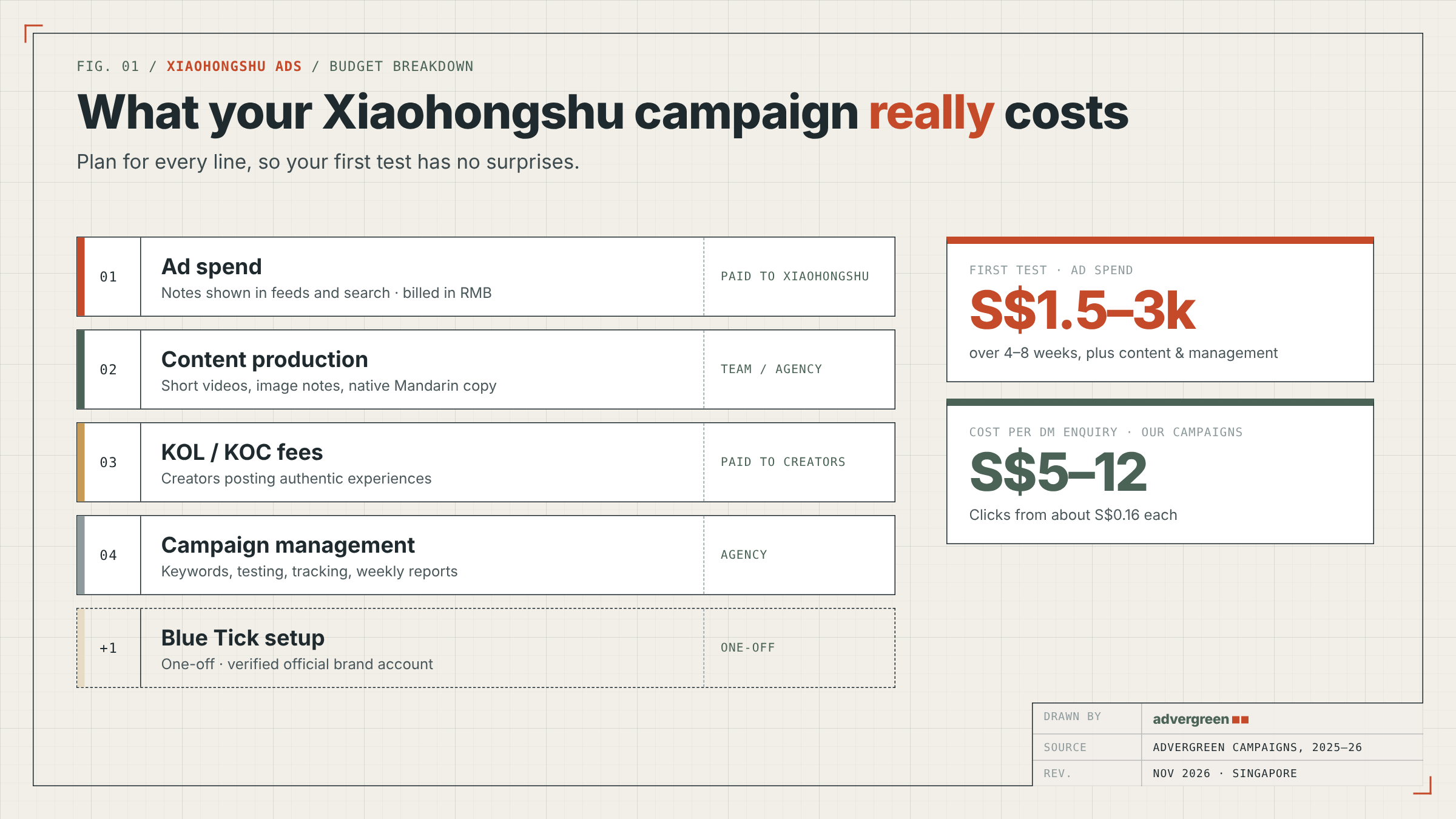
For most Singapore SMEs, a first Xiaohongshu ad test costs S$1,500 to S$3,000 in ad spend over four to eight weeks. Add content and management on top. Your real cost depends on your industry, your notes and how fast you reply. In our recent campaigns, clicks cost about S$0.16 and qualified enquiries by DM cost S$5 to S$12 each.
Your total budget has four main parts, plus a one-off account setup. Plan for all of them so there are no surprises.
Cost item | What you're paying for | Who you pay |
|---|---|---|
Ad spend (media) | Showing your notes in feeds and search. Billed in RMB, so S$ figures are approximate. | Xiaohongshu |
Content production | Short videos, image notes, Mandarin titles and copy written for how users search. | Your team or agency |
KOL / KOC fees | Influencer marketing: paying creators for authentic reviews and experience posts. Fees vary by audience size and fit. | Creators |
Campaign management | Campaign planning, keyword research, targeting, testing, conversion tracking and weekly reporting. | Your agency |
Account setup and Blue Tick | Setting up and verifying your official brand account with your business registration documents. | One-off, via your agency |
A word on benchmarks you'll find online: agency blogs publish Xiaohongshu cost-per-click figures for Singapore from about S$0.20 to over S$3. That spread is too wide to plan a budget with. Your own test data is far more useful. That's why we recommend a small, measured test before you scale.
What working with Advergreen costs: our 2-Month Trial is S$1,750 a month (S$3,500 in total) for first-time clients. Our 3-Month Xiaohongshu Package is S$5,000 after 50% EDGE grant support (standard price S$10,000). Ad spend is billed separately. See what each Xiaohongshu marketing Singapore package includes.
Which Xiaohongshu ad formats should you use?
Match the format to your campaign objectives. Start with search advertising if people already search for what you sell, and discovery feed ads if you need to create demand. Then boost the notes that already get saves and comments, and add creators once you know which message works.
Format | Where your ad shows | Best for you if… | What to measure |
|---|---|---|---|
Search ads | In results when people search keywords like 新加坡美食推荐 (Singapore food recommendations) | Customers already search for your category | Cost per DM enquiry, CTR |
Discovery feed ads | In the home feed of people matching your audience | Your offer is visual or new to them | Saves, profile visits, cost per enquiry |
Boosted notes | Your best organic notes, pushed to more people | A note already performs well organically | Cost per save, cost per DM |
KOL / KOC collaborations | On creators' accounts, as genuine experience posts | You need trust and real reviews | Engagement rate, enquiries from creator posts |
KOL vs KOC: a KOL (Key Opinion Leader) is a larger creator who builds awareness. A KOC (Key Opinion Consumer) is an everyday user with a smaller, loyal audience whose reviews feel like a friend's recommendation. For most SMEs, micro-KOC campaigns (a handful of well-chosen KOCs posting around the same time, often called KOC seeding) build community trust faster and cost less than one big KOL.
What results can you expect from Xiaohongshu ads?
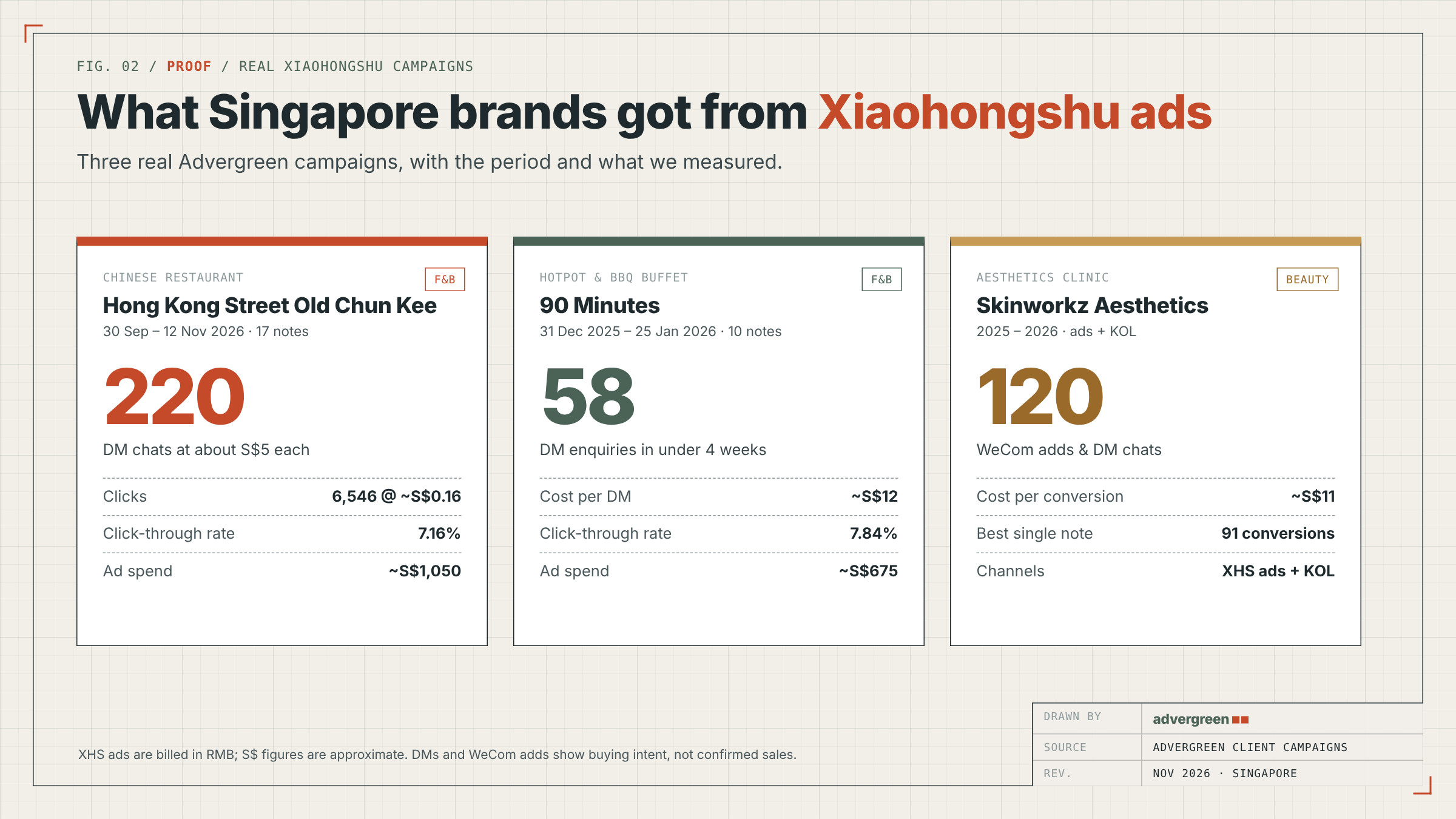
With the right notes and fast replies, Singapore businesses can see their first DM enquiries in the first two to four weeks. Here are three real Advergreen campaigns for Singapore brands, with the period and what we measured. DMs and WeCom adds show buying intent, not confirmed sales.
Client | Industry and period | Ad spend | Results |
|---|---|---|---|
Hong Kong Street Old Chun Kee | Chinese restaurant, 30 Sep – 12 Nov 2026 | About S$1,050 | 6,546 clicks at about S$0.16 each, 7.16% CTR, 220 DM chats at about S$5 each, 153 new followers |
90 Minutes | Korean hotpot and BBQ buffet, 31 Dec 2025 – 25 Jan 2026 | About S$675 | 58 DM enquiries in under four weeks at about S$12 each, 7.84% CTR, 5,279 clicks |
Skinworkz Aesthetics | Aesthetics clinic, 2025 – 2026 | Ads plus KOL campaigns | 120 WeCom adds and DM chats at about S$11 each; the best single note brought 91 |
What these campaigns had in common: native Mandarin content built around real searches, a clear next step in every note, and a team that replied to customer enquiries quickly.
How do you launch your first Xiaohongshu campaign in 30 days?
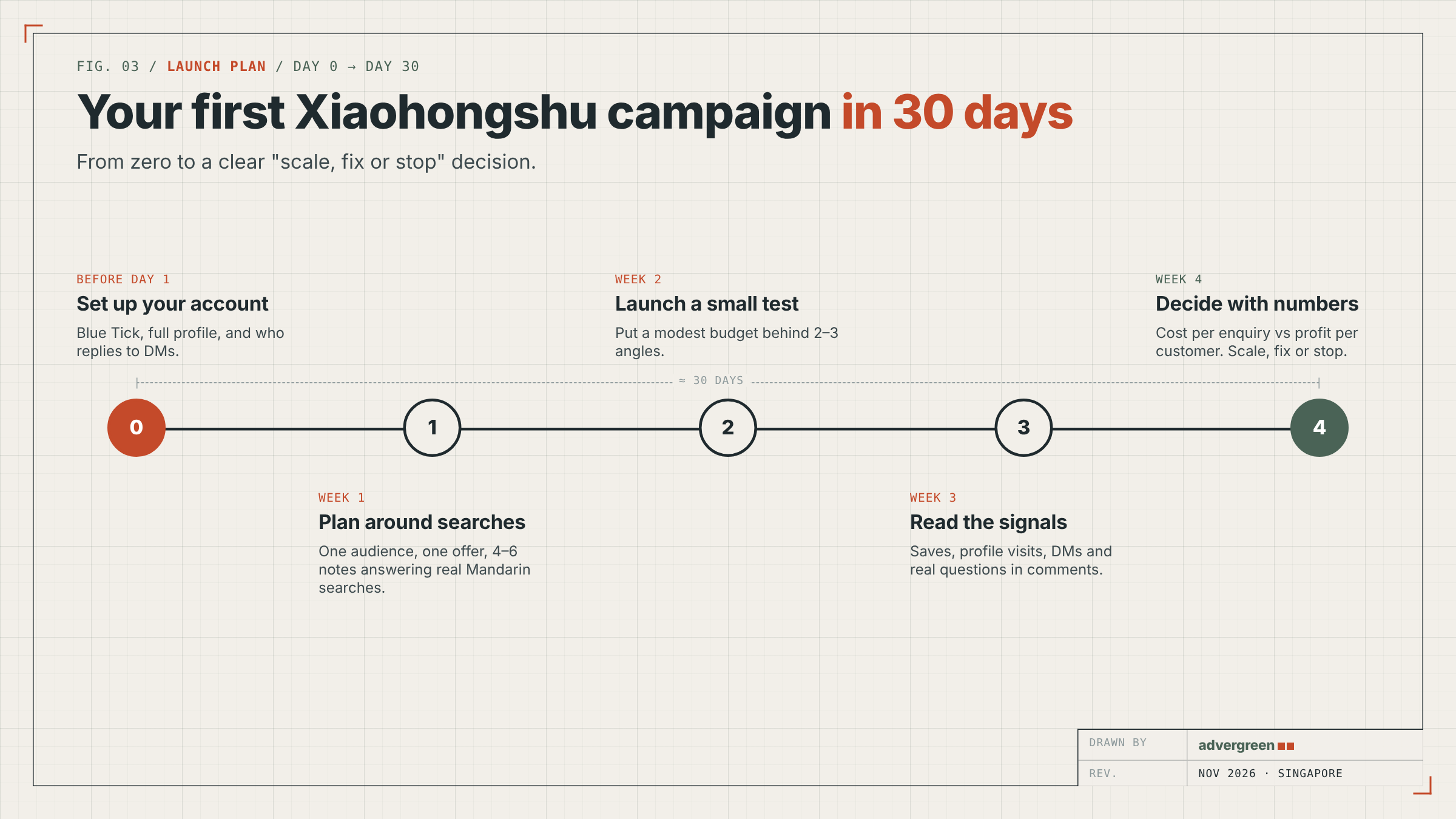
Follow these five steps to go from zero to a clear "scale, fix or stop" decision in about a month.
Before day 1: set up your account. Get your brand account and Blue Tick verification sorted, and complete your profile with your location, opening hours and what you offer. Decide who will reply to DMs, how fast, and your booking steps once someone is ready.
Week 1: plan around searches. Set your campaign objectives, then pick one audience and one offer. List the Mandarin phrases your customers type, such as 新加坡美容院推荐 (recommended beauty salons in Singapore), and plan 4 to 6 notes that answer them.
Week 2: launch a small test. Publish your notes, then put a modest budget behind two or three angles, for example a price guide versus a "what to expect" experience note.
Week 3: read the signals. Check which notes get saves, profile visits and DMs, not just views. Look at comment depth too: real questions in comments signal buying interest. Answer them in your next notes.
Week 4: decide with numbers. Compare your cost per qualified enquiry and your customer acquisition cost with your profit per customer. Then scale what works, fix what's close and stop what isn't working.
How do you know if your Xiaohongshu ads are working?
Your ads are working when each new customer costs you comfortably less than they're worth. Likes and views help the algorithm, but they don't pay your bills. Track these six numbers every week:
Metric | How to calculate it | What it tells you |
|---|---|---|
Click-through rate (CTR) | Clicks ÷ impressions × 100 | Whether your cover and title grab attention. Our recent campaigns hit 7–8%. |
Cost per click (CPC) | Ad spend ÷ clicks | How efficiently you buy attention |
Cost per DM enquiry | Ad spend ÷ DM enquiries | Your real cost of a conversation |
Lead-to-customer conversion rate | New customers ÷ qualified enquiries × 100 | How well your team closes |
Customer acquisition cost (CAC) | Total marketing cost ÷ new customers | What each new customer costs you |
Return on ad spend (ROAS) | Revenue from ads ÷ ad spend | Whether the ads pay for themselves |
Ask every new customer how they found you, and log it. Xiaohongshu's dashboard shows search impressions, clicks and DMs, but only your sales records show who actually paid. That simple performance tracking habit tells you your true customer acquisition cost.
6 mistakes that waste your Xiaohongshu ad budget
Translating your English ads word for word. Users can tell instantly. Write natively in Mandarin, around how they search.
Running polished brand ads. Xiaohongshu users trust real experiences, prices and pros and cons more than glossy campaigns. Peer credibility beats a perfect brand voice.
Chasing views instead of qualified enquiries. A note with fewer views but more saves and DMs is the one to boost.
Adding your WhatsApp number or links to the note. Xiaohongshu's ad rules restrict outside contact details such as links, QR codes and messaging IDs. Use the platform's own DM and lead tools.
Replying to DMs hours later. Your competitor is one tap away. Response speed wins the sale, so make sure someone with Chinese-language response capacity is on hand.
Scaling before you have proof. Increase paid media budget only when cost per qualified enquiry and lead quality stay steady for a few weeks.
Should you run Xiaohongshu ads yourself or hire an agency?
Run ads yourself if someone on your team writes native Mandarin, knows Xiaohongshu's ad rules and has several hours a week to test and reply. Hire a digital marketing agency if you'd rather focus on your customers. A specialist team then handles verification, content strategy, content creation, creators and ads.
If you compare agencies, ask each one:
Can you show real Xiaohongshu results, with the period and what was measured?
Who writes the Mandarin content, and is it native or translated?
Is ad spend separate from your fee, and are creator fees included?
Do you handle Blue Tick verification, and what happens if it fails?
How do you report on enquiries, not just views?
At Advergreen, our Singapore team handles Blue Tick setup, native Mandarin notes and videos, KOL/KOC sourcing and Xiaohongshu ads in one plan. If we can't get your account verified, you get a 100% refund of your Blue Tick fee. See our Xiaohongshu marketing Singapore packages.
Frequently asked questions
Can Singapore businesses advertise on Xiaohongshu?
Yes. Singapore businesses can set up a verified brand account and run ads to reach Chinese-speaking customers in Singapore and overseas. You'll need your business registration documents for verification. Your ads must also follow Xiaohongshu's advertising rules for your industry.
What is the minimum budget for Xiaohongshu ads in Singapore?
Xiaohongshu doesn't publish one fixed minimum for Singapore advertisers. As a guide, plan S$1,500 to S$3,000 in ad spend for a first test of four to eight weeks. Add content and management on top. Our 90 Minutes campaign got 58 DM enquiries from about S$675.
Do I need a Blue Tick before running ads?
Plan for it. Your ads run from your brand account, and a verified, official profile makes people more likely to message you. We complete Blue Tick verification before your ads go live.
Can I put my WhatsApp number in Xiaohongshu ads?
No. Xiaohongshu's ad rules restrict outside contact details such as links, QR codes and messaging IDs in promotional content. Use the platform's DM and approved lead tools, then move the conversation forward from there.
Are Xiaohongshu ads better than Instagram ads?
They do different jobs. Xiaohongshu reaches Chinese-speaking customers while they search and compare in Mandarin. Instagram reaches a broader English-speaking audience. If your customers search in Chinese before they buy, Xiaohongshu advertising usually brings warmer, more qualified enquiries.
How long until I see results from Xiaohongshu ads?
You'll usually see early signals like saves and DMs within two to four weeks. Stronger, steadier results take one to three months of consistent notes, creator testing and ad optimisation.
Do I need content in Mandarin?
Yes. Xiaohongshu users search and read in Chinese, so your titles, captions, hashtags and on-image text should be native Mandarin content. Translated English copy rarely performs.
Can I use the EDGE grant for Xiaohongshu marketing?
Yes, if you're eligible. Advergreen's 3-Month Xiaohongshu Package is EDGE pre-approved, with an estimated 50% claimable. Support is subject to eligibility and official approval. EDGE is reimbursement-based, so you pay first and claim after the project.
Ready to get found on Xiaohongshu?
Book a free 20-minute T³ Growth Review. We'll check whether your customers are searching on Xiaohongshu. Then we'll tell you honestly where to start, even if the answer is "not yet". Explore Xiaohongshu marketing with Advergreen →
About the author
Gideon Leong is the founder of Advergreen Digital, a Singapore marketing agency he started in 2020. Before that, he worked as a mechanical engineer and then as a head of digital marketing. His team has supported 50+ brands on Xiaohongshu. Advergreen is a MARKies Awards Singapore 2026 finalist for Most Effective Use – Performance Marketing.
Share this post